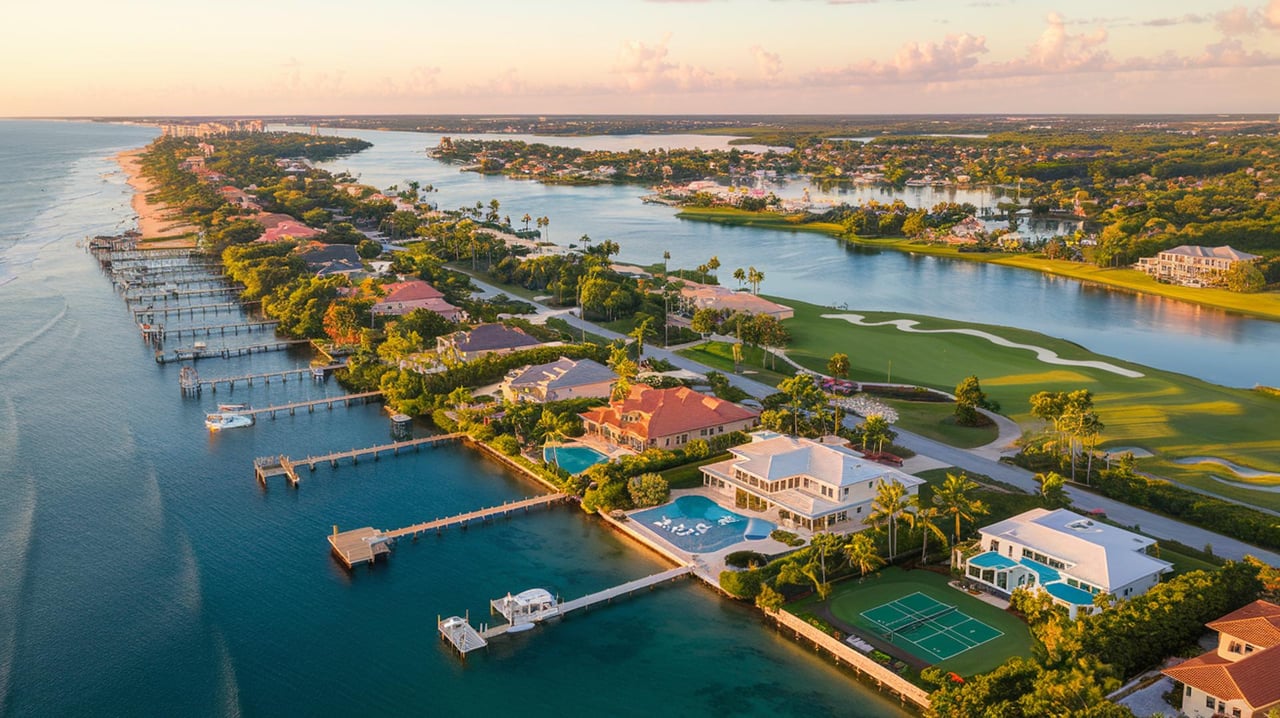
Within hours of each other in October 2024, Hurricane Milton carved a new inlet in Charlotte County and blew Midnight Pass fully open on Siesta Key, less than 30 miles apart. Why is one of them still a 16-foot-deep channel to the Gulf while the other has mostly filled back in?
The county's consultant puts it down to the sand in the channel, and that finding is behind the vote Sarasota County commissioners took on Sept. 22. For two years, Midnight Pass looked like a storm's lucky accident that the next storm might erase. The county now treats it as a long-term waterway, in the same family as Longboat Pass, Big Pass and New Pass. Even so, the force most likely to close it again is sand, and some of that sand would come from the county's own beach work just to the north.
Two inlets, one storm, two outcomes
Milton Pass in Charlotte County opened at about 100 yards wide and 8 to 10 feet deep. Your Observer reported that it is now largely filled in, citing the University of Florida Center for Coastal Solutions, which studies both inlets as Florida's two newest coastal features.
| Midnight Pass, Siesta Key | Milton Pass, Charlotte County | |
|---|---|---|
| Opened | Narrow channel cut by Hurricane Helene in late September 2024; fully reopened by Milton on Oct. 9, 2024 | Hurricane Milton, October 2024 |
| Condition reported Sept. 2026 | Holding about 16 feet deep and about 1,400 square feet of channel area for months | Largely filled in |
| County status | Commissioners voted Sept. 22, 2026 to plan for long-term management | Not applicable |
The Siesta Key inlet also has a longer story behind it. Building and dredging the Intracoastal Waterway changed how water moved through Little Sarasota Bay, according to Sarasota County's Midnight Pass page. The pass gradually migrated north until it threatened homes on Siesta Key. In 1983, the affected homeowners asked for permission to close it, on the condition that it be mechanically reopened farther south. That relocation never worked. WUSF dates the final closure to 1984 rather than 1983. It also reports that Hurricane Helene cut a narrow channel first, before Milton fully reopened the pass on Oct. 9, 2024.
The shell hash that holds the channel open
Mike Jenkins is a senior principal engineer with Geosyntech, the consultant that has worked with the county since before the 2024 storms. He told commissioners that the reason the pass has held is its sediment. The sand at the pass is coarse "shell hash," very different from the beach sand to the north. "It encourages inlet stability," Jenkins said, as reported by Your Observer. "You can hold a steeper slope."
The numbers show what that steeper slope means. The pass has kept its depth near 16 feet and its cross-section near 1,400 square feet for months. At peak tide, Jenkins said, enough water moves through it to fill an Olympic-size swimming pool in about 26 seconds. "It is open and it is trending towards open based on everything we've seen," he told the commission.
The channel's centerline still wobbles within a band about 60 feet wide, and county staff have surveyed its depth and position about once a week since Milton opened it. Charter captain Matt Fueyo described that movement to WWSB: "There was an entry on the north side and then as time happens and storms and everything shifted the sand."
The pass also hasn't faced a real test yet. There were no major tropical threats in 2025, and none so far in 2026. "Keep in mind," Jenkins said, "it opened during a storm, storms open inlets, but they certainly can close it."
The sand that could close it sits just to the north
Storms are the obvious risk. The less obvious one is beach nourishment. Jenkins told commissioners that the pass falls within the sphere of influence of the Turtle Beach nourishment project just up the shoreline. "We don't want to have a condition where we place sand on the beach and we have an inlet closure," he said, according to Your Observer. Any future nourishment will have to be planned around keeping the pass stable.
That creates a real conflict on the south end. Turtle Beach lost so much sand to Milton that Palmer Point Beach Park, at 9399 Blind Pass Road on the north end of Casey Key, can no longer be reached on foot. The county lists it as watercraft access only, with no parking. The same stretch of beach that needs rebuilding sits next to the inlet that most needs to stay clear. A county resiliency workshop is expected to cover both south Siesta renourishment and Midnight Pass, but no date had been set as of the Siesta Sand's Oct. 1 report.
If sand does refill the channel, the county already has a fallback. Under an emergency order, land-based equipment would come in from the north and remove about 25,000 cubic yards of sediment. For scale, more than ten times that amount was recently dredged from New Pass between Lido and Longboat keys.
What the Sept. 22 vote actually set in motion
Commissioners voted unanimously to move forward on five points:
- Keep collecting data and running models.
- Move ahead with channel markers and advisory signs.
- Study possible dredging of the two branches that connect the pass to the bay, to keep them safe for boats.
- Begin state and federal permitting to maintain the inlet at its current dimensions.
- Keep engaging stakeholders.
Item four matters most. Permitting to maintain the inlet at its current size is a multi-year process, and it is the step that would put Midnight Pass on the same footing as the other managed passes in the county. The planned signs will warn boaters about manatees and about paddlers and other human-powered craft. "I don't want to see it closed again for decades, it was a fight," Commissioner Teresa Mast said, as quoted by Your Observer.
Behind the vote is the question of what the open pass does for Little Sarasota Bay. The Sarasota Bay Estuary Program says more tidal flushing is a likely benefit. It also says changes to fish populations remain uncertain and lists possible trade-offs for seagrass, oysters, manatees and exposure to red tide. In February 2025, Your Observer reported that the estuary program's David Tomasko had watched tannin-darkened water flushing out of the bay. He expected clearer water to help seagrass overall, though fast currents were scouring some seagrass near the pass. Reports of better fishing come from residents, who told WWSB in 2025 that birds had returned and they were catching more fish.
Reaching the pass while the channel still moves
The markers and signs are approved but not yet installed, so for now a trip to the pass means reading the water yourself. These are the main ways in:
- Turtle Beach Park, 8918 Midnight Pass Road. It has a public boat ramp for motorized and non-motorized boats, a canoe and kayak launch, fishing facilities and beach access, and it is open 6 a.m. to 10 p.m.
- Turtle Beach Campground. The county-run campground has 39 RV and tent sites and a kayak launch for guests who bring their own boats or use a permitted vendor.
- Palmer Point Beach Park, reachable by watercraft only, and open 6 a.m. to sunset.
If you would rather rent or join a tour, the county keeps a list of permitted Turtle Beach operators. It includes Great Blue Outfitters–Ride and Paddle, SURFit USA, and TC Watersports/Sarasota Kayak Rentals, and the county notes that it does not endorse any one of them. Sarasota Kayak Rentals advertises a two-hour guided paddle from Turtle Beach to Midnight Pass. Get Up And Go Kayaking offers a clear-kayak tour with a stop to walk the beach, and its guides pick the route based on wind, tide and boat traffic. Murphs Surf rents kayaks and paddleboards for self-guided trips from a private marina launch at 8865 Midnight Pass Road. The shop says the paddle is short, but tide and weather can make it hard.
On the water, the bay sets its own rules. Little Sarasota Bay is a state Manatee Protection Zone. The FWC asks powerboat operators to obey posted speed signs, stay in deep channels when they can, avoid seagrass and shallows, and keep at least 50 feet from manatees. The FWC's Sarasota County manatee map shows a year-round slow-speed zone around the Blind Pass and Midnight Pass lagoons. However, the map itself says its zones were accurate as of October 2017, before the inlet existed in its current form, so posted signs on the water take priority. Sea turtle nesting season runs May 1 through Oct. 31, according to Mote Marine Laboratory. That leaves 19 days this year when Mote's guidance applies: give turtles and hatchlings room and keep lights off the beach at night.
For people who run trips out of the pass, the two years of change have mostly been good news. "There are so many more shells and more activities that we've been able to do down in this region as well," Fueyo told WWSB.
Shane Lewis grew up on Siesta Key and still watches the south end closely, from Turtle Beach sand levels to new markers in the channel. If you own near Midnight Pass Road or Blind Pass and wonder how the reopened inlet affects what your home is worth, Shane Lewis can run your instant home valuation and go through the numbers with you.